Bayesian Clinical Trial Design
Flexibility and speed, without costly or complex overheads to clinical development.
Bayesian Clinical Trials
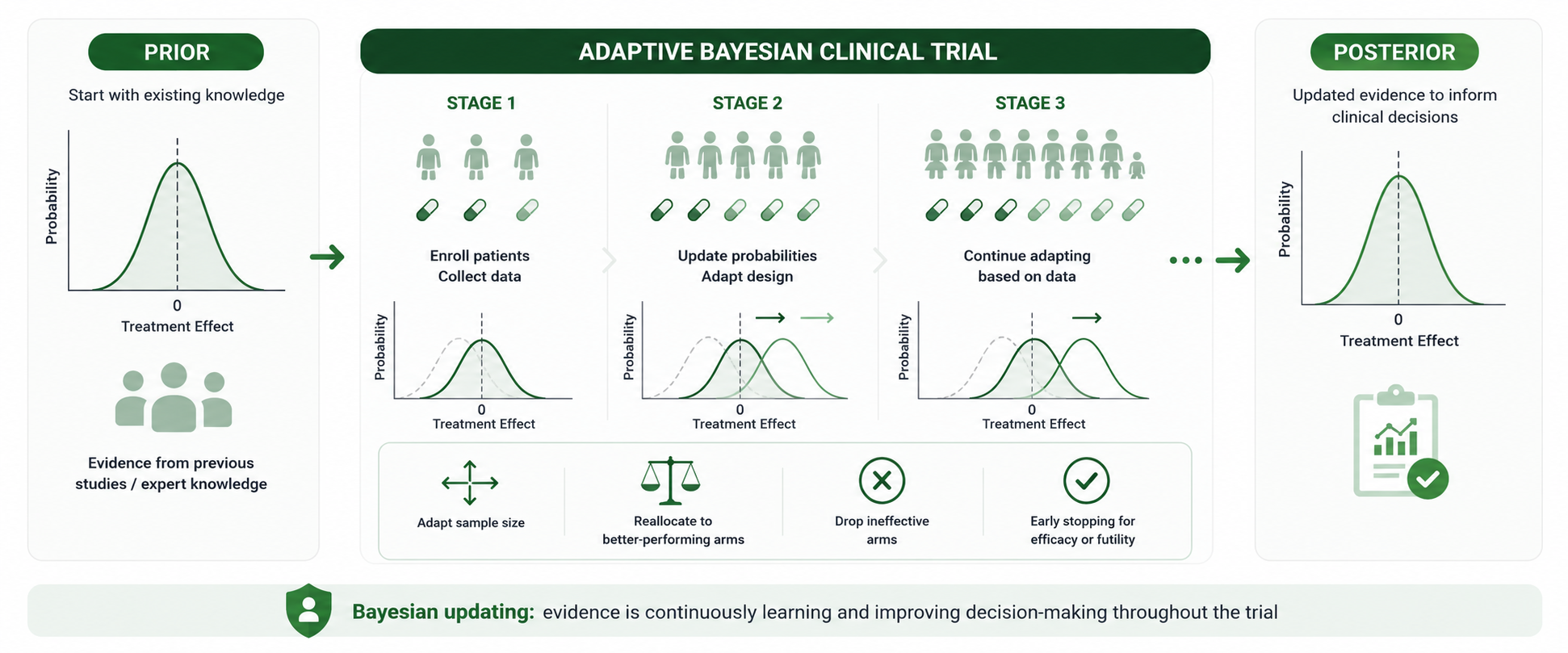
Bayesian clinical trials leverage a statistical framework that combines prior knowledge (from past studies or expert opinion) with accumulating trial data to guide decisions. These decisions can address different aspects of clinical development, for example:
- Deciding which doses are safe (in Phase I)
- Defining the optimal dose (in Phases I/II)
- Deciding whether a drug shows promise in Phase III based on early-phase data
This adaptive use of accumulating data makes Bayesian trials more flexible than traditional fixed-design trials, allowing decisions to be updated as evidence emerges and helping teams move faster through the clinical development process.
How does Cogitars support the design of Bayesian clinical trials?
We have designed and implemented more than 75 Bayesian trials, from IND submission/protocol through submission of the Clinical Study Report.
We have deep experience engaging with regulators on these designs, including novel Bayesian methods we've developed internally.
Our goal is to use Bayesian statistics as a mathematical tool to make better use of trial data, support stronger decisions in clinical development, and ultimately help get drugs approved faster and more cheaply.
The Bayesian Designs We Implement
Bayesian designs aren’t a single method but rather a framework that is applied differently depending on the question/s a trial needs to answer.
Below are the types of designs design families we use most often, spanning early dose-finding through late-phase decision-making.
Phase I, Dose escalation and dose finding
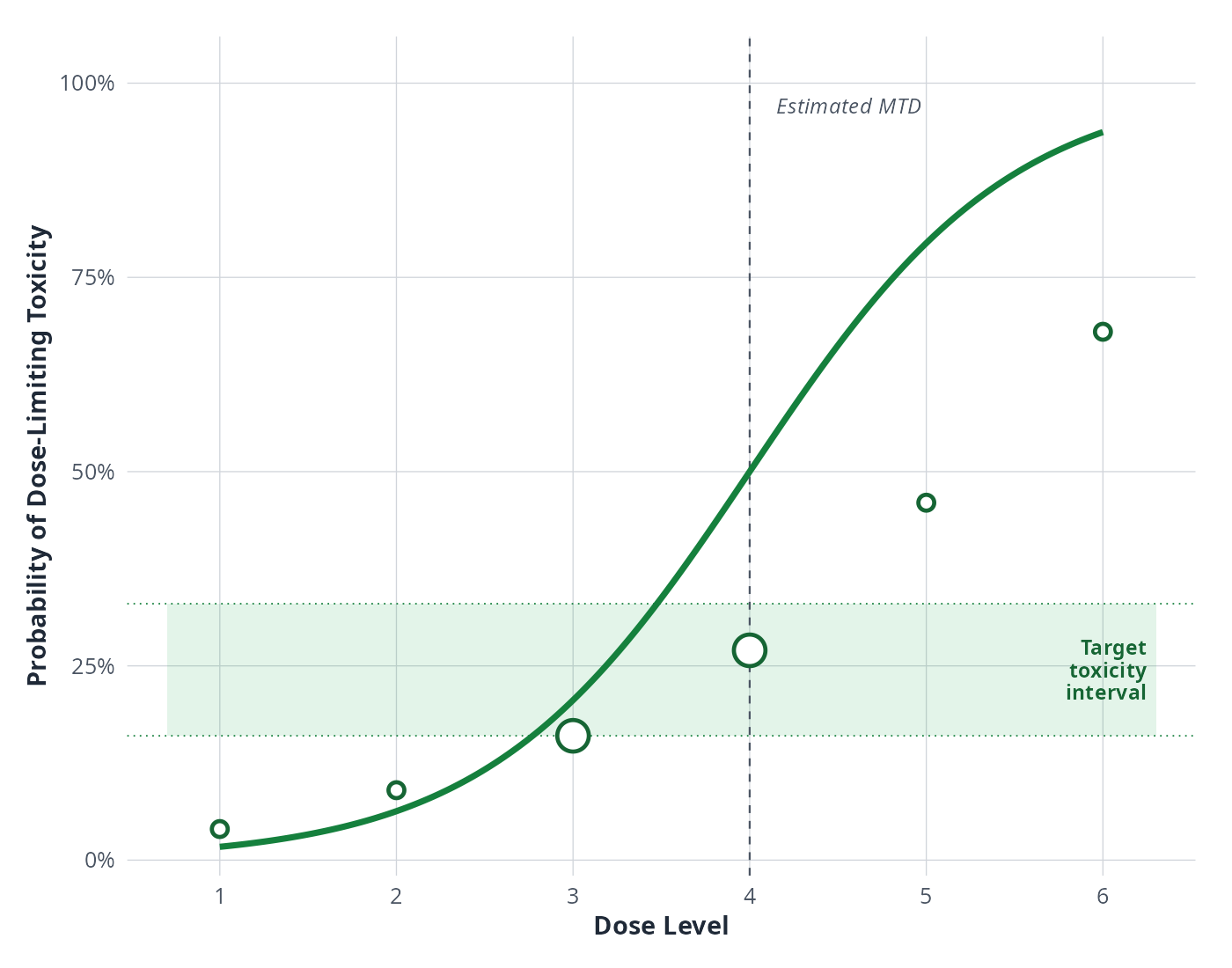
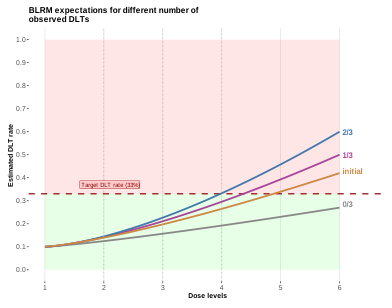
- BLRM (Bayesian Logistic Regression Model): a model-based design that fits a dose-toxicity curve, updated after each cohort and recommends the next dose/s. It's the workhorse for complex escalation settings — combination therapies, multiple schedules, long-term toxicity, immunotherapy drugs. More information on the BLRM can be found here: https://cogitars.com/blog/blrm-phase1
- BOIN (Bayesian Optimal Interval design): a model-assisted design that uses pre-tabulated dose-decision rules instead of real-time model fitting. It is simpler to implement and more similar to older rule-based methods like the 3+3 design.
Phase I/II, Dose optimization (Phase I/II)
Since the Project Optimus initiative launched in 2021 (https://www.fda.gov/about-fda/oncology-center-excellence/project-optimus), the FDA introduced a requirement for sponsors to carry out dose optimisation to select the dose that had the best risk-benefit balance. This goes beyond the previous paradigm of selecting a phase II dose based on the MTD to take to further development.
Cogitars has its own solution to support dose optimisation (more information here: https://cogitars.com/blog/project-optimus-part1 and https://cogitars.com/blog/project-optimus-part2) and we also implement other dose optimisation designs like the U-BOIN and the BOIN12.
Phase II/III, Probability of trial success
Beyond individual trial designs, Cogitars uses Bayesian predictive probability and assurance calculations to estimate the probability a trial will hit its endpoint given the data observed so far or the probability that a trial will be successful in a subsequent trial (e.g. predict the probability of success in phase III based on the data observed in phase I/II)
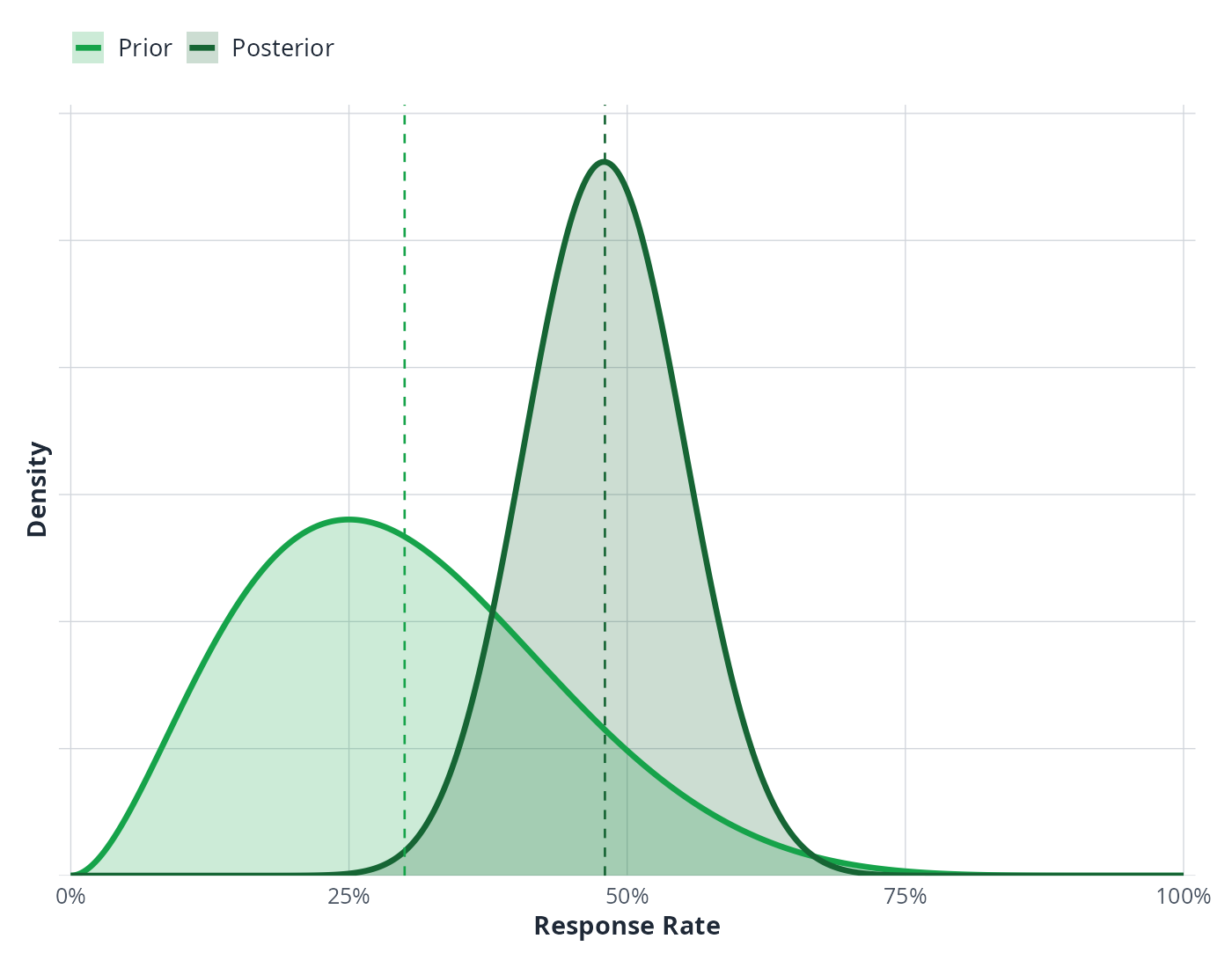
Probability of Trial Success is a tool that allows us to calculate the probability of a trial achieving success in the future. It is the Bayesian counterpart of the frequentist statistical power, which provides strictly the probability of detecting an effect if that effect exists and is invariant to emerging data. Probability of trial success, or assurance, is updated according to data collected in the trial the same way our expectations change as we obtain more information.
These calculations support Go/No-Go decisions at interim looks, planning for Phase III registrational trials, decisions for portfolio-level prioritization, and communication with boards and investors about interpretable and realistic trial outcomes.
Other methods and tools we draw on:
- Bayesian sample size re-estimation and trial simulation, to stress-test operating characteristics — type I error, power, expected sample size — across plausible scenarios before a protocol is finalized
- Bayesian hierarchical models, for basket and umbrella trials that pool information across cohorts or disease types with small individual sample sizes
- Seamless / master protocol designs, combining phases (e.g. Phase I/II/III) under a single adaptive framework.
Frequently Asked Questions
A Bayesian clinical trial combines prior knowledge (from past studies or expert opinion) with accumulating trial data to guide decisions.
It allows us to continuously update the probability that a treatment works or that is safe as new patient data arrives, rather than waiting until a fixed sample size is reached to run one final analysis.
This makes trials more flexible than traditional fixed-design trials and allows us to move faster in the clinical development process.
Traditional frequentist designs rely on predetermined sample sizes, fixed hypotheses or rigid decision rules (e.g. 3+3 for dose escalation). In general, they ask "would this result be unlikely if the treatment had no effect?"
Bayesian trials, on the other hand, update continuously as data comes in, combining it with prior knowledge to estimate the probability the treatment works. This allow continuous monitoring of the data (without the need for multiplicity control) and lets the trial adapt in real time—stopping early, dropping ineffective arms, adjusting sample size.
This makes trials smaller, nimbler and, arguably, more ethical.
- More efficient use of the data collected: results can be evaluated as they come in, rather than waiting until a fixed endpoint, so trials can stop early for success, futility, or safety concerns.
- Inclusion of prior information: data from previous studies, historical controls, or related patient populations to be formally incorporated, which can reduce the number of patients needed — especially valuable in rare diseases where enrollment is hard.
- More flexible: resources like sample size or treatment allocation can shift mid-trial as evidence accumulates, cutting cost and time without compromising rigor.
- Easier to interpret: results are expressed as direct probability statements — for example, "there's a 92% probability this treatment is better than placebo" — rather than p-values and confidence intervals, which are often misread even by experienced clinicians. This makes trial results more intuitive to communicate to physicians, patients, and decision-makers.
- They might be the only option: in rare diseases, it might be impossible to recruit enough patients to conduct a frequentist design. In this situations, Bayesian designs with inclusion of expert knowledge or data from previous studies are the only option available.
Together, these advantages leads to smaller trials and faster readouts. Bayesian designs are particularly useful for sponsors that require flexibility on a low budget.
- Early-phase dose escalation and dose optimization studies, across all indications
- Particularly relevant in oncology, since Project Optimus delineating requirements for dose optimisation was launched
- Phase 2/3 trials with limited sample sizes or high uncertainty, tend to benefit the most from Bayesian adaptive approaches.
- Rare disease studies
- Pediatric studies
- Platform trials testing multiple treatments at once, where Bayesian rules make it easy to add, drop, or compare arms as new data comes in
The barriers are mostly practical, not regulatory:
- Bayesian designs require specialized statistical knowledge and expertise to build, simulate, and validate.
- Most biostatistics teams are trained in traditional frequentist methods. Building this capability takes time, investment and building experience afterwards.
- Lingering misconception that Bayesian priors introduce unwanted subjectivity, even though modern designs use rigorous, pre-agreed methods to justify and stress-test them.
- Bayesian studies sometimes require a bit more statistical work upfront than frequentist studies. In order for trials to have more flexibility, Bayesian studies use trial simulations to make sure that none of the possible scenarios work under the underlying prior assumptions.
Finally, many organizations still perceive that Bayesian clinical trials pose a regulatory risk although, in our experience, this is not the case with the main regulatory agencies.
We have designed and implemented more than 75 Bayesian trials, from IND submission/protocol through submission of the Clinical Study Report.
We have deep experience engaging with regulators on these designs, including novel Bayesian methods we've developed internally.
Our goal is to use Bayesian statistics as a mathematical tool to make better use of trial data, support stronger decisions in clinical development, and ultimately help get drugs approved faster and more cheaply.
This is still a popular belief but the regulators have embraced Bayesian designs for ~ 2 decades. The use of Bayesian response adaptive models for Phase 1 studies is one of the key elements of the FDA’s Critical Path Initiative (2004) and has been advocated by the European Medicines Agency adopted guideline on small populations (EMA, 2006).
More recently, in 2018, the FDA introduce the Complex Innovative Design program (CID) which allows sponsors to request extra meetings with the FDA to discuss a proposed complex design — including Bayesian adaptive designs — before running a pivotal trial.
In January 2026, the FDA published its draft guidance on the use of Bayesian methods in clinical trials (https://www.fda.gov/regulatory-information/search-fda-guidance-documents/use-bayesian-methodology-clinical-trials-drug-and-biological-products). This guidance formally extends Bayesian methods to pivotal trials (not just early-phase or adaptive designs), provided sponsors directions to pre-specify their analysis and justify their assumptions upfront. It is a clear sign that the regulators see Bayesian approaches as a mainstream option and not an exception.
The Pfizer/BioNTech Covid vaccine clinical trial, one of the most well-known trials in recent years, was a seamless phase 1/2/3 trial and it used a Bayesian methodology to estimate vaccine efficacy (https://www.nejm.org/doi/full/10.1056/NEJMoa2034577). This trial was a good example of how Bayesian methodologies can be applied in pivotal trials in high-stakes situations and well-received by the regulators.
Other studies that use Bayesian methods are:
- Nilotinib + imatinib combination trial (Novartis, https://www.tandfonline.com/doi/abs/10.1080/10543400902802409) which used a Bayesian design to guide dose escalation in phase I. This was one the first studies with this method and is still widely used by Novartis.
- The I-SPY trial (https://www.nejm.org/doi/full/10.1056/NEJMp1602256) is a platform trial that uses Bayesian response-adaptive randomization to steer patients toward drugs performing well within their tumor subtype in real time. It's since evolved into I-SPY2.2, a Bayesian SMART (sequential multiple assignment randomized trial) design.
- Vemurafenib basket trial (https://www.nejm.org/doi/full/10.1056/NEJMoa1502309) — used a Bayesian hierarchical model to pool efficacy signals across BRAF-mutant cancer types with small cohort sizes, a template many later basket trials followed.
Planning a Bayesian trial?
Talk to our statisticians about your design, simulations and decision rules.